

Channel intelligence is the result of connecting channel data across marketing, sales, and incentive systems to explain what drove revenue and why.
Channel data is the record of activity from channel marketing and sales systems. Channel intelligence is the ability to get insights and make decisions based on that data when it’s connected across systems and revenue can be attributed to specific activities.
Identity resolution means using consistent IDs for channel partners, customers, products, and campaigns across systems. Without it, you can’t trace one partner’s activity from a campaign click to an incentive claim to a closed deal.
Three options: native connectors (pre-built integrations like Pardot’s Salesforce connector), API integrations and iPaaS platforms (Workato, MuleSoft) when native links don’t exist, or a central data destination (data warehouse, CDP, or unified channel platform) that all systems push to.
Channel attribution assigns credit to the activities that influenced a sale using models that range from first-touch (all credit to the first interaction), last-touch (all credit to last interaction before close), and multi-touch (credit distributed across multiple interactions). Most channel programs attribute marketing activity to revenue but rarely apply attribution to incentive spend.
Distribution channels move trillions of dollars in product every year. Goods journeying from manufacturer to distributor to customer is the backbone of the global economy. But you wouldn’t know that from how manufacturers manage their channel sales and marketing data. That data is stuck in software purgatory.
Channel data lives in various programs used by different departments within manufacturer or supplier companies—marketing platforms, incentive programs, CRMs, PRMs, partner portals, etc. These tools are all made by different software companies who sell them to you IKEA-style. It’s up to you to put them together and connect them in a way that’s useful. You can pay thousands in implementation costs for companies to set the software up for you, and pay even more for a consultant or specialist to tell you how to get the software to do what you need it to. Even then, data may not flow seamlessly between systems.
The result is a stack of disconnected systems that are run by different departments and don’t exchange key sales and marketing information.
Having channel data is one thing. Channel intelligence is when you have the data, you know what it means, and you know what decisions to make based on what the data is telling you.
If you’re like most manufacturer or supplier companies, you have channel data but not channel intelligence. Let’s talk about what channel intelligence looks like and how to get it.
Why Channel Data Is Hard to Get
Direct sellers get the privilege of easy access to all the sales and marketing information they need. They own the customer relationship, the CRM record, the campaign engagement, and the sales data. They have an eagle-eye view of their sales and marketing world.
Channel sellers have more of an insect-level view. They can see their own domain and, beyond that, it’s mostly just fragments. The distributor owns the transaction data, which they might share if they’re sufficiently motivated to.
The result is a data gap that grows every year. Three obstacles keep it from closing:
Distributor reluctance. Distributors are often unwilling to share customer and sales data with manufacturers. That’s partially because they don’t want manufacturers using the data to cut them out of the picture and market/sell to their customers directly. On top of that, many treat their customers’ purchase information as private.
Tools built for the wrong audience. Most CRMs, marketing automation platforms, and analytics tools were built for business-to-consumer (B2C) selling—for cookies, paid media, and direct response. They treat the buyer’s journey as a straight line from seller to customer.
A bloated, disconnected tech stack. Omdia found 261 companies in the channel software ecosystem in 2025, up 64% from the 159 Forrester identified in 2020. The increasing number of platforms indicate two things: either existing tools aren’t doing the job they’re supposed to, or new tools that do different things are entering the market (or both). Each of these tools generates its own data. Reports use different language and fetch data points that might contradict each other. Add on the fact that, in many companies, different departments use different language for the same metrics.
Channel data is flowing from potentially hundreds of directions, but it’s like water flowing through punctured hoses that aren’t property connected. Channel marketers still don’t have a reliable, efficient way to capture and contextualize that data and make it useful. It’s not telling a story they can understand or offering insights they can base decisions on.
What Is Channel Intelligence?
Channel intelligence is when you can explain what drives revenue and why.
Having channel data isn’t the same thing as having channel intelligence. Channel data tells you some of what happened. Channel intelligence tells you everything that happened, why it happened, and what to do next.
The difference is clear in the questions marketing leaders can answer. With channel data, you can say how many emails were sent and opened, how many partners enrolled, how many incentives were claimed. With channel intelligence, you can say which campaign drove a seven-figure deal, which incentive structure changed partner behavior, and which mid-tier partner is on a trajectory that justifies more investment.
How Do You Achieve Channel Intelligence?
You achieve channel intelligence by collecting the right channel data, connecting the systems that collect that data, and having efficient methods to analyze and present that data. Channel intelligence isn’t a new tool. It’s the result of getting the right tools to operate as a single environment, so the data is accurate and the conclusions are coherent.
Four data sources have to connect:
- through-channel marketing engagement
- incentive program activity
- CRM and PRM sales data
- intent signals
On their own, each tells a partial story. Connected, they explain revenue.
Connecting them comes down to three things:
1. Identity Resolution
Channel intelligence depends on every system using consistent IDs for partners, customers, products, and campaigns. If your marketing tool, CRM, and incentive program each use a different ID for any of these, you have no way to follow that partner’s activity from a campaign click to an incentive claim to a closed sale. With matching IDs, though, systems can fetch and exchange relevant data. This is called identity resolution.
Partners
If your marketing platform calls them Partner #4471, your CRM and your incentive program should call them Partner #4471 too. Different IDs in different systems mean you can’t tell that the partner whose customer clicked on last quarter’s campaign is the same partner who claimed an incentive last month and closed a deal last week.
Customers
A customer’s name could get input or spelled three different ways across three systems: “Acme Corp,” “Acme Corporation,” and “Acme,” for example. You know they’re all the same customer, but your systems may not. A shared ID ensures all these are recognized as the same customer and lets you track which marketing activity influenced which customer.
Products
Channel incentives and marketing campaigns are often tied to specific products—a promotion on a new product line, a rebate on a certain configuration, a volume tier on a particular family, etc. Manufacturers often use product SKUs as IDs to simplify things. If the SKU on the product itself matches the SKU in your incentive program, your CRM, and your campaigns, you can tell whether the incentive or marketing ID associated with that SKU drove a purchase.
Campaigns
Each marketing campaign you run needs a unique code that tracks all activity it generates, from first click to closed deal to incentive payout. The campaign code needs to travel through the entire chain of these events:
A partner sends a co-branded email with campaign ID attached in a URL’s UTM code. → A customer clicks the email URL and fills out a landing page form where the code is present as a tag or URL in a hidden custom field. → The campaign ID travels into the CRM with the new lead. → The lead makes a purchase with the partner. → The code is present on the closed-won record. → The partner files a sales claim to earn an incentive reward for the purchase, and the ID is present on the claim.
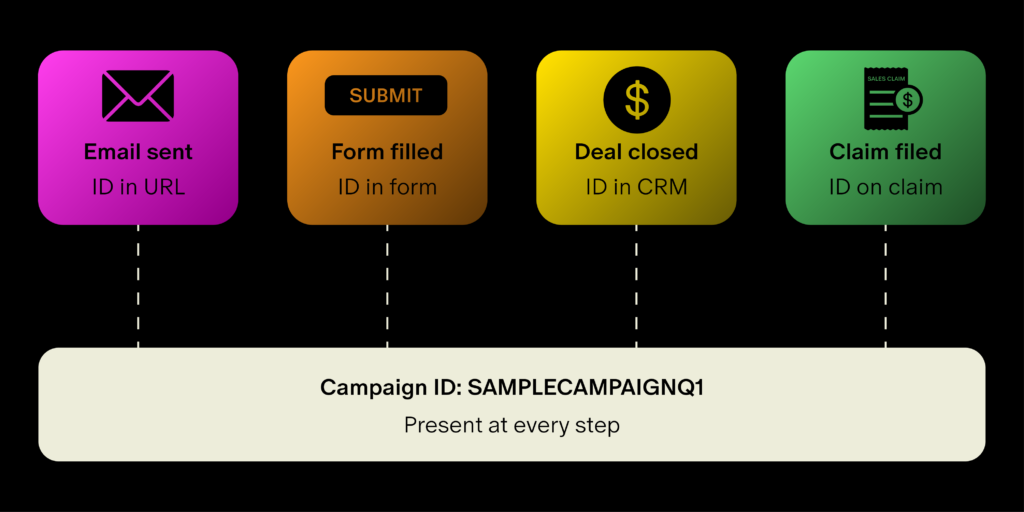
When the campaign ID is present throughout the process, you can see that your marketing campaign and/or incentive promotion led to revenue.
Most channel technology is set up for identity resolution. CRMs like Pardot sync UTM fields into Salesforce Lead and Contact records, for example, and attach the same campaign code to a partner’s email if it shows the sales record. The campaign ID stays with the data as it moves from one system to the next.
Where disconnect usually happens: Channel data often gets lost on the way from incentive programs to other systems. Incentive platforms don’t typically share information with CRM or PRMs by default and may refer to partners with different IDs than other systems do.
Pick one partner ID and make sure every system uses it.
2. Data Integration
Identity resolution gives systems a way to recognize data across different systems and allows that data to travel from one system to another in one- or two-way exchanges. Without it, all you have is matching IDs sitting in disconnected systems, like people sitting in the airport with their passport and ticket ready, but no plane to take them anywhere.
There are three ways channel programs typically integrate data.
Native Connectors
Most major channel software comes with pre-built connectors to other common platforms. Pardot has a Salesforce connector. Salesforce has connectors for most major marketing automation tools like Hubspot and Mailchimp. PRMs typically connect natively to Salesforce. Take advantage of those pre-built connectors, as they’re the simplest integration path. You configure them once and both systems stay in sync.
API Integrations and iPaaS
When two systems don’t have a native connector, you build the bridge yourself using application programming interfaces (APIs). For teams without engineering resources, integration platforms (iPaaS) like Zapier, Workato, or MuleSoft handle the connection without custom code. You configure rules (ie. “when a claim is filed in the incentive program, push the partner ID, campaign ID, and amount to the matching opportunity in Salesforce”) and the iPaaS executes them.
A Central Data Destination
Once you’re working with three or more systems, integrations get unmanageable. The cleaner path is to push data from every system into a single destination such as a data warehouse (Snowflake, BigQuery, Redshift), a customer data platform (CDP), or a unified channel platform. The destination becomes the source of truth where data from all systems can be analyzed together.
Most modern marketing and sales tools are built to integrate with each other. Most CRMs have native connectors for major marketing platforms. Past that, your options are API integrations, iPaaS, or central data destinations. Which solutions you should use depends on your unique tech stack needs.
A unified channel platform is the alternative to building integration across separate tools. Extu’s Partner Experience Platform is the first of its kind in that it’s built specifically as a channel intelligence platform. Channel marketing, incentive, sales, and intent data live in a single system, so identity resolution and data integration happen within the platform itself.
Use native connectors first, fill the gaps with APIs or iPaaS, and push everything into one central destination.
3. Attribution Modeling
Identity resolution and data integration get the right data into the right place. Attribution modeling tells you which activity actually drove revenue. Without it, connected data still leaves you guessing. You can see that a partner ran a campaign, claimed an incentive, and closed a deal, but you don’t know which of those activities deserves credit for the sale, or how much. With attribution modeling, connected data turns into a clear answer about what worked and what didn’t. This is called attribution modeling.
There are three steps to build channel attribution.
Define Attributable Events
Attribution starts with deciding which activities count as “touches,” or moments in the customer’s journey that influence the sale. Touches include marketing engagements (email opens, content downloads, webinar attendance, landing page visits), partner-led activity (demos, meetings, co-branded events), and incentive interactions (claim submissions, training completions, threshold achievements).
Define the full list of events you’ll track and make sure each one is captured in a system that’s integrated with your attribution destination.
Select an Attribution Model
The model is the rule for how credit gets divided when multiple touches influence a deal. The simplest models are first-touch (all credit to the first interaction) and last-touch (all credit to the final interaction before close).
Multi-touch models distribute credit across multiple events with different weighting rules. For most channel programs, a position-based model (heavier weight on the first touch and the closing touch, with the middle touches sharing the rest) is the practical starting point. You can refine the model later based on what the data shows.
Pick a System of Record
The attribution math has to live somewhere accessible to everyone. In most cases, that’s the CRM. The CRM holds the deal record, campaign records, and the rules that connect them. Wherever attribution lives, it should be the single source teams pull from when reporting on what worked.
Most channel programs already attribute marketing to revenue. Salesforce Campaign Influence and similar tools give marketing teams a clear, defensible answer to “which campaigns drove pipeline.” The marketing-to-sales attribution chain is the most mature part of the typical channel program.
Most channel programs spend significant budget on SPIFFs, MDF, and rebates without attribution data on whether the spend actually changed partner behavior. They see that incentives were claimed and revenue was generated, but not whether the deal would have closed without the incentive.
One Extu client added a single question to their claims form: “Would you have made this purchase without the incentive?” This definitively classified incentives as a revenue-driver.
Define your touches, pick your model, and put it in the system everyone reports from.
In Conclusion
Identity resolution, data integration, and attribution modeling help you turn channel data into channel intelligence. They match IDs across systems, move data from where it’s generated to where it can be analyzed, and translate the connections into clear answers about what drove revenue.
Channel intelligence allows you to:
- Identify the campaigns that drove pipeline and the ones that didn’t, so you can double down on what works.
- See which co-op and MDF investments produced revenue, so you can put channel marketing budget where it will get the most returns.
- Distinguish growing partners from coasting ones and spot the mid-tier accounts with growth potential, so you can invest early in high-potential partnerships.
- Separate incentive structures that change partner behavior from incentives that just pay out for sales that would have closed anyway, so you can stop wasting budget on efforts that don’t drive revenue.
- Measure each partner’s full revenue contribution across the buyer’s journey, not just the deals they happen to close, so you can recognize and reward partners who influence sales at every stage.
The shift from channel data to channel intelligence is the difference between explaining how busy your channel is and proving how productive it is. Between defending budgets in instinct-driven conversations and defending them with revenue contribution. Between running a channel program and running a profitable one.