
Through-channel marketing automation (TCMA) and SPIFFs are two of the best ways to increase channel partner engagement and revenue. TCMA lets partners connect with their audience with easy-to-send campaigns and SPIFFs motivate actions that move revenue. Most brands include both in their channel partner strategy, but separately. Partners market in one place, earn SPIFFs in another, and the connection between effort and outcome gets lost.
Your hidden advantage isn’t a bigger budget. It’s combining the strengths of TCMA and SPIFFs for an even more effective channel partner strategy.
What TCMA and SPIFFs Each Do Well
TCMA helps partners act like modern marketers without needing a marketing team. They can launch co-branded emails, social posts, and landing pages; access approved content; and see performance analytics so they know what works.
Most sales professionals do not expect to hit their quotas. Offering SPIFFs can be an effective way to reignite their fire and boost morale. Combining short-term goals with quick bonuses is often just the motivation salespeople need to close deals.
(Salesforce)
SPIFFs (short-term, behavior-based incentives) turn priorities into action. Want to move a new product line, accelerate sell-through, or boost first-service bookings? SPIFFs make it obvious what partners need to do and reward them quickly.
When you combine them, TCMA promotes qualified activity while SPIFFs reinforce the activity that turns into revenue. When they’re aligned, every click, lead, and sale lives in the same story.
Why Most Companies Separate Them (and Why That’s a Problem)
The typical channel stack looks like this: partners launch campaigns via a marketing portal or a patchwork of tools; sales are reported somewhere else. Incentives live on a separate site, and analytics require a trip through spreadsheet hell.
That fragmentation creates real drag:
- Double data entry. Partners repeat themselves across systems (or just skip reporting altogether).
- Missing attribution. It’s hard to show which campaign or piece of content influenced the sale that earned the SPIFF.
- Slower payouts, lower trust. Proof is scattered, reviews take longer, and confidence in the program erodes.
- Disconnected strategy. Marketing optimizes for clicks while Sales optimizes for payouts and neither sees the full picture.
The Hidden Advantage of Combining TCMA + SPIFFs in Your Channel Partner Strategy
When SPIFFs live inside (or are tightly integrated with) your TCMA ecosystem, the loop closes:
- Clear attribution. Campaign activity, lead creation, invoice upload, and payout are linked. You can prove what’s working with clear evidence.
- Faster motivation loop. Partners launch a campaign, capture leads, report sales, and redeem rewards without leaving the flow. Momentum builds instead of stalling between systems.
- Smarter offers and content. Real sales data flows back into your content and incentive strategy. You’ll learn which products, messages, and actions deserve the next boost.
- Tighter alignment across teams. Marketing and Sales look at the same dashboards, measure the same outcomes, and tune campaigns and SPIFFs together.
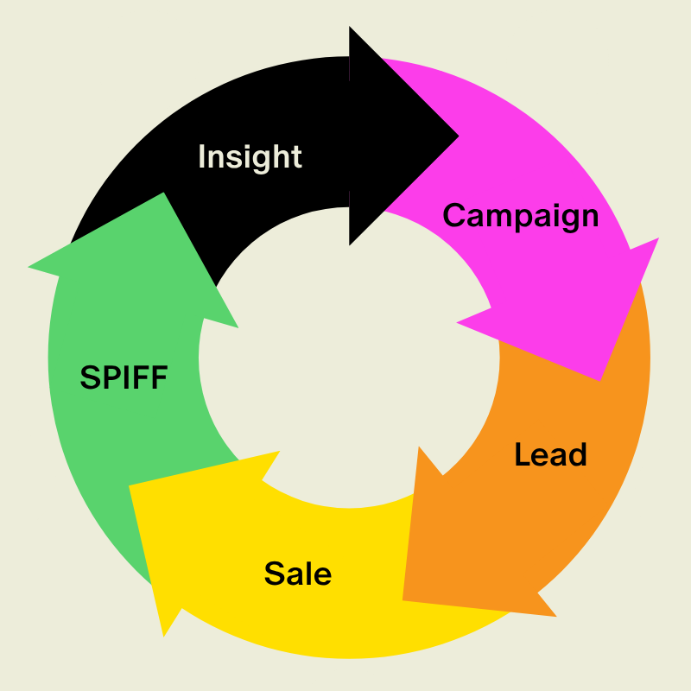
Think of it as a flywheel: Campaign → Lead → Sale → SPIFF → Insight and back to a sharper campaign and a better-targeted SPIFF.
What Integration Looks Like in Practice
Here’s a day-in-the-life view of an integrated channel partner strategy:
- Partner logs in once. Their account’s dashboard shows live campaigns to send, simple sales reporting tools, and any active promotions or points balance.
- They launch a campaign. Choose the product focus, preview the co-branded email and landing page, and schedule with a click. The system tracks sends, opens, and clicks.
- Leads arrive. Contacts from the landing page roll into a lightweight CRM list. The partner sees who engaged and books follow-ups without exporting anything.
- They close a deal. Reporting the sale is a short, guided step (e.g., upload invoice, confirm product). If data feeds are connected, many claims are auto-verified.
- The SPIFF triggers. Once the sale is verified, the reward posts. If you use points, the balance updates instantly; if cash-like payouts, they process on a predictable cadence.
- You get the insight. On your dashboard: participating partners, campaigns sent, sales tied to those campaigns, rewards paid, and cost-per-result. You can see whether to keep, tweak, or stop.
Everything the partner does and everything you measure stays in one, easy-to-understand story.
The Strategic Payoff
For channel marketers:
You stop arguing about “influence” and start proving it. Campaigns and content that consistently show up in rewarded sales get more investment; those that don’t get fixed or retired.
For sales leaders:
SPIFF spending becomes easier to defend. You’re not just paying for volume, you’re paying for verified behaviors that trace directly back to opportunities and invoices.
For partners:
The experience is simpler. They send more campaigns because they’re easy. They report more sales because it’s fast. They stay engaged because rewards hit with less friction.
For finance and leadership:
The numbers show a clean chain from program dollars to outcomes. When programs are this transparent, you fund what works with confidence.
How to Get Started (Without Ripping and Replacing)
- Pick one target. Choose a single product line or launch where you already supply campaigns and already pay SPIFFs.
- Write one rule. “Send Campaign X to at least Y contacts; report an invoice for Product Z → Earn Reward.” Keep proof simple.
- Connect the dots you already have. Even a lightweight integration (campaign sends + invoice upload, for ex.) builds the initial loop.
- Measure one page. Show before/after results, partners covered, sales tied to the campaign, rewards paid, and cost-per-result.
- Tune and scale. Double down where it works; add more campaigns, products, or regions in phases.
The goal isn’t a perfect channel partner strategy, but a coherent one. Once the loop exists, improvement gets easier.
Conclusion: Marketing Drives Sales and Sales Validate Marketing
TCMA and SPIFFs aren’t competing priorities. They’re complementary forces that strengthen each other when they share the same space, the same data, and the same definition of success. Put them together and you get more than campaigns and payouts. You get proof that partners are engaged, offers are working, and that revenue moved for the reasons you planned.
Your partners shouldn’t have to choose between marketing and motivation. When they can do both in one place, you can see the whole story. You can stop guessing and start growing.