

Great channel programs are axed all the time, even when they’re working. They’re killed for the same reason anything in business is killed: they’re not making money. At least, no one can prove they’re making money. Truthfully, channel programs are usually driving positive results, but they’re not set up to prove it. Attribution — the ability to attribute channel program activities to revenue generation — is usually a manual and time-consuming process, if it’s possible at all.
Why is it like this? It’s not unreasonable to think it’s by design.
I don’t mean that there’s always some saboteur behind the scenes making sure revenue can’t be tied clearly to channel marketing and sales activities. But the inherent processes and designs of channel programs often make attribution difficult.
How Did We Get Here?
There are a lot of factors that cause broken channel attribution, some technological and some human.
Channel Marketers Use Software Made for B2C Marketers
Much of the martech software that channel teams rely on was made with B2C marketing in mind. B2C is direct and linear. The product supplier delivers the marketing that influences a B2C customer and owns the store they buy a product from — the supplier generally has direct access to marketing and sales data.
In the channel, where things are non-linear, things aren’t so simple. Despite the 200+ channel platforms on the market, 61% of channel marketers still report on their results manually with spreadsheets.
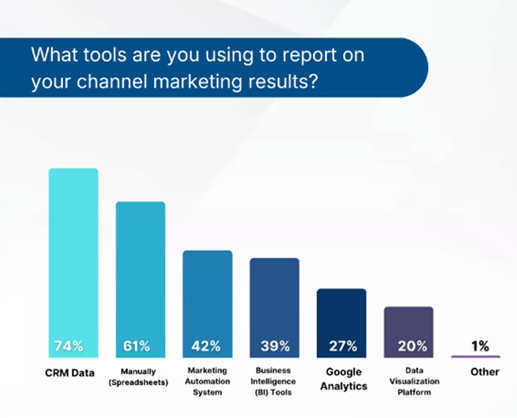
(Source: Channel Marketing Associations’ State of Channel Marketing Report 2025)
Even with 200+ platforms available to them, channel marketers struggle to achieve revenue attribution, because those platforms were built for B2C needs.
Software Is Designed for Increasingly Specialized Tasks
As more software enters the market, it’s designed to help with increasingly specific, specialized tasks. The marketing technology landscape reached 15,384 tools in 2025 — a 9% year-over-year increase and a 100x jump from 2011. This is largely due to the “software longtail” phenomenon, described by Chiefmartec and MartechTribe’s State of Martech 2025 report here:
“For years, we’ve described the distribution of commercial software in the Marketing Technology Landscape as a ‘long tail’ — a few very large and popular platforms in the head, a few hundred category leaders in the torso, and a long, long, loooong tail of startups and more specialized niche products.”
Federated Software Can Create Performance & Security Issues
Federated architecture is a way of building enterprise software that allows different systems and technology to operate together but autonomously. It was conceived to address the problems of complexity in software and business management, namely integrating data from multiple independent sources. This type of architecture has downsides, though. Managing disparate systems leads to:
- Performance issues (slower query responses and data retrieval)
- Increased security risks
- Inconsistent data
- Often requires specialized tools and skilled personnel to manage
While federated architecture is often a workable solution for complex business environments, it can get more difficult to manage as the tech stacks.
Data Ownership Is Unclear
The average organization today uses 897 applications. By necessity, all that software has to be managed and overseen by different departments and different people. No one person or team could handle it all. This creates data silos, where one team needs data that another team is in charge of.
Marketers spend more time (24%) collecting data than analyzing it (22%).
Source: Marketing Profs
68% of organizations cite data silos as their top data management concern.
Source: Dataversity
Working with siloed data increases delays in getting data while decreasing the chances that data is accurate or consistent.
Partners Don’t Share Sales Data
One of the biggest hurdles to channel attribution is the lack of second-party data — data that belongs to another business. In this case, it’s the sales data that partners aren’t inclined to give you. They’re often actively disinclined to give you that data out of fear you’ll market directly to their customers and eat into their margins. Without building some kind of process into your partner experience that makes it worthwhile and convenient for them to give you that data, they’ll never bother.
“Vendors are often surprisingly unaware of who buys and uses their products, relying on partners to provide the information needed to understand their end customers.”
—Larry Walsh, Channelnomics
How Do We Fix It?
The problems that cause channel attribution to break are multi-faceted, so the solutions have to be multi-faceted. Not only do software architecture and features often need to change, but policies and culture must be updated too.
Create a Better Data Culture
Data normalization: Many businesses refer to the same data with different vocabulary. “Clients” vs “accounts” vs “contacts,” for example. Even if you can’t get everyone to the point that they’re using the same words for the same things in every meeting, awareness that everyone needs to use the same terminology is the first step to a culture that prioritizes data normalization.
Regular data audits: An estimated 70% of CRM data decays every year. That’s data that most ICPs and sales & marketing strategies are based on, so it needs to be accurate. Review and update data from your CRM and other key sales and marketing systems every quarter.
Role-based access: Role-based access means that different people in your organization have different levels of access to your systems. A finance role might authorize a user to review and approve MDF, for example, while a program manager role allows the user to track program activities (enrollments, logins, etc.). Limiting system views and access based on roles means that people can’t edit data they shouldn’t, and they waste less time looking for what they need in your systems.
Defined data governance: You can’t keep data accurate and organized if you don’t define who owns what. A data governance team should:
- Create role-based access controls
- Detail the organization’s process for managing critical data assets
- Define data ownership and responsibilities
- Specify how data should be handled and by whom
- Establish data governance tools
- Audit processes and procedures
- Define data goals, roles, and duties
91% of technology leaders identify data governance as their second-highest challenge for the next 3-5 years.
Source: PWC
Data lifecycle plans: You should have clear rules about when and how to update, archive, or delete data so you can stop outdated records from accumulating in your system. Create data retention timelines and archiving protocols, for example, for inactive partners.
Use Better Technology
Integrated platforms: Integrated systems are alternatives to federated architecture. Instead of making different systems work together independently, the strongest integrated systems share common definitions and a single data layer, with common partner identifiers persisting throughout. Data flows automatically between integrated systems without manual export, import, or reconciliation. Achieving this requires a common data model that every system reads and writes to, APIs or a shared database layer that lets systems exchange data in real time, and a governance layer that enforces consistent definitions, access controls, and data validations across systems.
Automated data hygiene: Along with regular data audits, you can automate data hygiene to prevent incorrectly entered data from becoming a problem later on. Use validation rules to reject records that don’t meet defined standards. Flag things like missing fields, unrecognized partner IDs, and mismatched formats.
Automated deduplication: Many platforms — like Salesforce and Microsoft — can automatically deduplicate data for you with the right configuration. Check to see if you have this feature turned on in your CRM or PRM.
Intelligent merge rules: Intelligent merge logic is a step beyond deduplication. Instead of just preventing or deleting duplicate data, you can create rules about which data is merged across systems and how. If one record has more recent contact details while another has a more complete purchase history, for example, you can update the record with fresher contact details without losing the purchase history data.
Offer a Better Partner Experience
Progressive profiling: There’s only so much data you can ask partners for before they disengage and decide they don’t have time for you. Progressive profiling is the practice of asking for the data you need across multiple interactions, so you’re not demanding a partner’s life story in one exchange. Prompt them for feedback after a purchase, for example, or after they’ve downloaded a resource from your partner program.
Incentivized data submission: You can tie data submission directly to the reward-earning process. If a partner sells a product that qualifies for an incentive reward, they typically submit documentation to validate the sale. This makes sales data submission a fluid part of the reward-earning process, especially if you offer a convenient file upload tool that allows partners to upload images of documents instantly to your incentive program.
Single sign-on: If partners can interact with your brand from multiple places—corporate sites, e-commerce sites, incentive programs, or partner portals—consider integrating those web presences and offering partners a single sign-on option. Partners’ experiences with you are more convenient when they can get anywhere they need to go from one location, rather than memorizing multiple URLs.
Personalization: Personalization covers a broad range of features. Email tokens that insert the recipient’s name or company are a basic form of personalization. Other personalization features include audience segmentation (creating separate partner lists according to tier, region, type, etc., in order to send them relevant promotions, offers, and messaging); dynamic content delivery that automatically sends different materials to different segments; behavioral triggers that activate automated communications based on certain actions; and AI-driven recommendations for relevant campaigns, training, or promotions to offer partners based on their profile data.
Partner enablement: Any process or tool you use to better equip partners to sell your product can be considered partner enablement. This commonly includes training such as onboarding, learning management systems (LMS), product and installation certification programs, etc. It could also include digital asset and resource libraries that allow them to access things like sell sheets, videos, thought leadership, and case studies. The key to effective partner enablement is to integrate these tools into the partner journey. If they start selling a new product line, for example, they should automatically receive or be directed to content that familiarizes them with that product line.
Conclusion
Attribution doesn’t come automatically built into any channel tech stack. Achieving it requires developing a data-aware culture, using technology that facilitates the right data connections, and delivering a partner experience built on trust and mutual benefit. When you have all those things in place, you can follow partner activity and engagement to revenue with clarity and confidence. Not only can you say what’s driving partner revenue now, you can use your source of reliable, relevant data to predict partner trends and behaviors, so you can make proactive channel investment decisions.