

Suppliers provide market development funds (MDF) to their partners to fund local marketing and demand generation efforts. Despite making up nearly half of the average supplier’s channel marketing budget, 60% of MDF go unused every quarter and most suppliers can’t measure the revenue impact of what is used. This article offers suggestions on solving this problem by updating technology and processes to an outcome-based MDF strategy.
Every quarter, suppliers send money to distributors, dealers, and channel partners to build demand and sell products through the channel. Where do those market development funds (MDF) go after they leave the supplier’s budget? How and when are they spent?
Most suppliers can’t exactly say. They get no sales data from channel partners to follow the trail from marketing investment to revenue impact. When their CFO asks these sales and marketing leaders, “What did our MDF produce?”, they’re asking a detective who’s trying to solve a case after all the witnesses have gone home.
According to Forrester, MDF make up nearly 50% of the average supplier’s total channel marketing budget. But 60% of allocated MDF go unused every quarter, with 43% of partners using less than half of what they’re allotted. That means 30% of the average channel marketing budget is unaccounted for, if not completely wasted.
Why Do Market Development Funds Go Unused?
When you see a figure like “60% of MDF go unused,” your instinct may be to blame partners for not bothering to claim their funds. That blame would be misplaced. Low MDF utilization isn’t partners’ fault; it’s a result of how partner programs are designed and managed.
MDF programs are often gatekept with requirements. Funded activities must be pre-approved, partners must co-invest or meet size/revenue thresholds, etc. A study by The Channel Co. showed that large partners (> $100M) get 38% of their marketing budget from suppliers whereas medium ($10 – 100M) and small (<$10 M) partners get 27% and 15%, respectively. Suppliers are investing mainly in their largest partners, i.e. the ones most likely to already have dedicated marketing teams and the resources to run campaigns without help.
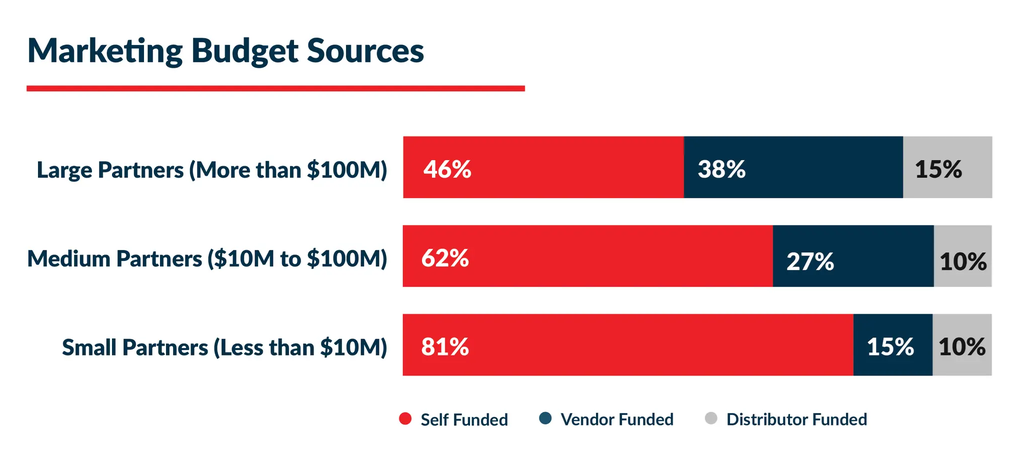
(Source: The Channel Co.)
But low MDF utilization is only half the problem. Even when partners claim and spend their MDF, most suppliers have no way to tell when it produces revenue and how much.
Why Are Market Development Funds So Hard to Measure?
Partners are the ones who have a relationship with the end buyer and influence over them. What partners don’t usually have are great marketing resources. MDF give partners the ability and freedom to market how they want, sometimes with parameters so the supplier can have some control over the messaging.
The problem is that the supplier doesn’t see the leads generated, contacts reached, or sales influenced by the marketing they funded. When that partner closes a deal three months later, there’s no clear way to connect that revenue back to the MDF.
According to Forrester, these four things are in the way:
Buying Complexity
Most products sold through the channel already have long sales cycles, and they’re getting more complex. More stakeholders are joining the decision-making process. As the buying committee grows, so does the number of people who could have been influenced by an MDF-funded campaign. By the time a deal closes, the connection between marketing and its influence is nearly impossible to reconstruct.
Missing Data
In most channel marketing programs, the proof of a partner’s performance stops at activity metrics — campaigns sent, events attended, etc. The MDF reimbursement process is usually built to confirm that approved activities happened, not to capture whether they produced revenue.
Friction and Process Gaps
Suppliers need partners to share sales data to connect MDF activity to outcomes. For a variety of reasons, partners don’t do this, whether because of channel conflict (i.e. distrust and concern over competition) or because the process of submitting is time-consuming and they have no motivation to do so.
Technology Limitations
Despite years of channel technology investment, many suppliers are still managing multi-million-dollar MDF programs in spreadsheets and email. The infrastructure doesn’t match the importance of the MDF investment.
Developing a Better Market Development Funds Strategy
(That’s Outcome-Based, not Activity-Based)
An outcomes-based MDF strategy solves the problem of low utilization and the inability to measure results. Starting with the program design decisions on how MDF is allocated, you build toward the measurement infrastructure that connects spending to revenue. Here’s how to do both:
Define what success looks like before funds are released.
In a world where 60% of MDF go unused, utilization may feel like success. It’s not.
Before funds are released, the supplier and partner should agree on what the campaign’s goal is, whether that’s a lead or revenue target, selling X amount of a specific product/service, or reaching a particular customer segment.
This does two things:
- Gives the partner a clear objective to reach instead of a budget to burn.
- Allows the supplier to determine if the MDF was worth the investment.
Success must be defined before the campaign runs, so you require proof of progress, not just proof of activity.
Simplify and automate the approval process.
If every MDF request goes through the same approval process, whether for email campaigns or trade shows, then the approval process is inefficient. It’s discouraging smaller, easy-lift marketing activities that make your brand more consistently visible.
Build different levels of effort into the approval process:
- Small requests below a defined threshold get automatic or expedited approval.
- Mid-range requests go through a streamlined review with a short turnaround.
- Large or non-standard requests get full review.
This keeps scrutiny and time focused on where it’s best spent — on the investments large enough to warrant it.
Replace co-investment requirements with performance-based ones.
Many MDF strategies require partners to fund a portion of the investment before receiving reimbursement. The idea is that partners will make better use of MDF if they have skin in the game. Sounds reasonable. But the reality is that it excludes partners who can’t (or won’t) “pay to play,” and sometimes those are the partners that could make the most out of MDF.
Performance-based requirements accomplish the same goal without the barrier. A few examples:
- Number of customers from a target segment added to a campaign audience before launch
- Target number of leads generated or customers reached
- Target number of product demonstrations or quotes issued
- Revenue or units-sold threshold hit
- Target number of new or reactivated customers
With performance-based requirements, the partner is still bought-in. Their time, effort, and reputation are on the line. But the barrier shifts from “can you afford to participate?” to “can you get results?”
Allow rollover for pre-approved programs.
When the MDF expires at the end of the month or the quarter, it reinforces short-term thinking and strategies. Partners execute whatever marketing they can finish in time, not necessarily marketing that supports sales goals and builds sustained demand.
An MDF rollover policy helps partners carry out longer-term, strategic marketing. You can offer a targeted exception for programs designed to run longer than 90 days. For example:
- Product adoption campaigns
- Multi-touch outreach sequences
- Training programs
- New market or territory entry programs, relationship-building with unfamiliar customer segments
- Co-branded content series (i.e. whitepapers, videos, case studies)
- Seasonal demand generation programs
The rollover MDF policy should be a targeted exception for partners who are active or have high growth potential, giving them more opportunities to increase their customer reach and sales.
Provide ready-to-execute campaigns instead of funds.
One of the biggest barriers to MDF utilization is that most partners don’t have the marketing expertise or resources to build campaigns. Instead of doling out funds and waiting to see what partners do with them, suppliers can build the campaigns and make them available for partners.
This doesn’t have to mean more work for the supplier marketing team. Channel marketing technology makes it easy to scale campaign creation and delivery. For example:
- Asset library: a centralized, searchable source of campaign assets organized by product, audience, region, and format, so partners can find what they need without asking the supplier’s marketing team
- Co-brandable templates: emails, landing pages, social posts, and print materials with locked brand elements and editable fields for the partner’s logo, contact details, and local offer
- AI-generated content: tools that generate or adapt campaign copy based on product, audience segment, and local market context
- Audience segmentation: rules-based filtering that automatically routes campaigns to the appropriate partner based on defined criteria like region, tier, or product specialty
- Automated campaign delivery: campaigns delivered to partners on a consistent basis, ready to deploy with minimal to no effort
- Role-based access: partners only see the assets and campaigns relevant to their region, product line, or tier, reducing noise and making the right content easier to find and use
Using a platform to quickly, consistently send partners campaigns gives suppliers more control over messaging while allowing partners to better connect with their customers. It also creates the opportunity to connect marketing engagement data to partner sales and revenue data, so you can see exactly which partners and campaigns deliver successful outcomes.
Move MDF-funded marketing onto a unified channel platform.
To connect marketing activity to revenue, it’s best to manage channel marketing, sales activity, and incentive programs in the same place. A unified partner platform simplifies the partner experience and streamlines channel management while making it possible to see which partner activities drive revenue.
Specifically, look for these features and capabilities:
Multi-tier program management
Suppliers typically manage separate partner initiatives in separate systems for each. A unified platform lets the supplier run segmented programs across all tiers simultaneously, with the right content, incentive structure, and reporting for each partner segment, without fragmenting operations or multiplying administrative overhead.
Real-time campaign visibility
When partners run campaigns through a system that’s accessible to the supplier, proof of performance is built-in, visible to both sides. The system should capture which campaigns were offered, which partners sent them, how audiences engaged, and which activities generated leads.
Connected incentive and marketing data
Marketing and incentives are typically managed in separate systems with no data exchange. A partner runs an MDF-funded campaign in one platform and submits incentive claims in another. The supplier usually can’t evaluate whether the two are working together or just running in parallel. When they’re managed on the same platform, you can see whether marketing helps increase the behaviors rewarded by incentives.
Connecting campaigns to pipeline
Partner sales data is some of the most crucial information needed for accurate MDF measurement. But partners tend not to share this data, for good reasons: it takes time; it benefits the supplier more than them; and it creates an opportunity for the supplier to go around them to market directly to their customers.
Incentives change that dynamic. Partners can earn rewards for submitting sales claims through a unified platform, so sharing data isn’t a one-sided ask — it’s part of a program that benefits them too. The data integrates directly with campaign and incentive reporting, connecting marketing activity to closed revenue.
First, second, and third-party data in one view
A unified platform consolidates three levels of data important for attributing MDF spend to revenue: first-party data from the supplier’s own campaigns, second-party data from partner sales claims and submissions (usually from incentive promotions), and third-party intent signals from aggregators like Bombora that indicate which customers and partners are researching products in your category. When you can access all this data, it tells the full story of the partner journey: from intent to engagement and activity, to closed sale, to brand loyalty.
Predictive intelligence
When marketing, incentives, and sales reporting share data architecture, patterns emerge that you couldn’t see otherwise. Which partners’ activity is trending upward? Which are disengaging? Which MDF investments are generating pipeline versus expiring without impact? Over time, this data history becomes the foundation for predictive analytics — moving partner marketing and management from reactive to proactive.
Moving MDF execution onto a unified platform doesn’t just help you move to an outcome-based MDF strategy — it helps you build a data foundation that makes every channel investment smarter.
In Conclusion
Wasting MDF isn’t an inevitable cost of channel marketing. It’s a result of outdated program designs that can be changed.
The point isn’t to chase a perfect ROI, but to develop a mature, outcome-based MDF strategy. By defining success upfront, removing barriers to partner participation, offering partners easily executable campaigns, and running all of it on a platform that connects marketing activity to closed revenue, you can manage MDF in a way that generates inarguable evidence. Not only will you be able to answer the question “What did MDF produce?”, you can be confident that your MDF and channel marketing strategy will get progressively better over time.