
A guide to how B2B marketing attribution works, including the models and software necessary to connect marketing spend to revenue.
In this article:
Business-to-business (B2B) marketing attribution is the practice of identifying which marketing activities influenced a purchase decision and assigning credit accordingly. It answers the question every CFO eventually asks: did the investment work, and how do you know?
If you can connect a marketing dollar to a revenue outcome, you can defend your budget, optimize your programs, and stop funding initiatives that don’t make money.
Much to many marketers’ dismay, though, B2B marketing attribution is one of the most complex problems in marketing. It’s not that the concept is difficult; it’s because most attribution tools and models weren’t built for B2B.
To understand why this is and what impact it has on B2B marketing, let’s start by understanding what an effective B2B attribution model looks like.
What Is B2B Attribution Modeling?
What is B2B attribution modeling? It’s the logic beneath any attribution program defining how credit gets distributed across the touchpoints in a buyer’s journey. The model you choose determines what what decisions get made.
There are five models in common use. Each represents a different theory about how buying decisions.
| Model | Where credit goes | Why it doesn’t fit B2B |
|---|---|---|
| First-touch | The first interaction that brought the buyer in | B2B buying cycles span months and involve multiple stakeholders; first touch is rarely the deciding one |
| Last-touch | The final interaction before a deal closes | Ignores every influence that built the relationship leading up to close |
| Linear | Every touchpoint equally | Treats a product demo and an automated email as equivalent contributions |
| Time-decay | Touchpoints more heavily the closer they occur to close | Ignores top-of-funnel and mid-funnel programs that influenced late-stage conversion |
| Multi-touch | Touchpoints weighted by their statistical contribution to conversion | Most accurate model, but requires a controlled data environment |
Each of these models has its benefits. First-touch attribution helps you understand which channels are introduce new buyers to your brand. Last-touch is valuable if you’re optimizing a conversion funnel where the final interaction is the thing you have the most control over. Linear and time-decay models are often better fits for longer B2B cycles where no single touchpoint is obviously decisive.
B2B attribution modeling should account for buying cycles that span months, buying groups that include multiple stakeholders who may never interact with marketing directly, and revenue paths that run through partners and intermediaries the vendor doesn’t control.
B2B Multi-Touch Attribution
B2B multi-touch attribution is the most accurate model available. Rather than applying a fixed rule, it distributes credit based on how each interaction contributed. A multi-touch model can tell you, across hundreds of deals simultaneously, that a particular content type deserves 24% of the revenue credit while a specific campaign type accounts for 38%, and while updating those figures with new data.
For B2B organizations with enough data and solid measurement infrastructure, multi-touch attribution modeling produces insights that single-touch models can’t. It shows which initiatives contribute to pipeline contribution, which produce activity metrics that seem meaningful (but aren’t connected to revenue), and where investments would have the greatest impact.
Its requirement and its limitation are one in the same: B2B multi-touch attribution needs every touchpoint, from brand awareness to closed deal, to exist in one, connected data environment. Systems that distribute digital marketing, reward partners, log meetings/calls, and record sales systems all need to share a common data layer.
Multi-touch attribution is only as complete as the data it’s given. It needs data on every meaningful touchpoint in a single, connected data environment. In B2B, where the buying journey routinely moves through partners, intermediaries, and stakeholders operating entirely outside the vendor’s systems, some parts of the buying journey will always be inaccessible. Multi-touch attribution models can still fail B2B marketers if they don’t have the data to optimize them.
B2B Marketing Attribution Software
B2B marketing attribution software turns the concept of attribution modeling into operational reality, while removing the manual work required. It automates data collection, applies the attribution model continuously, and surfaces insights with live reporting that updates as new activity comes in.
Platforms range from standalone attribution tools to modules embedded in revenue intelligence and marketing automation suites. Most connect natively to Salesforce, HubSpot, Marketo, and similar systems, and they’ve become meaningfully easier to implement and interpret over the past several years.
The data blind spots created by B2B’s multi-party buying structure is a problem for B2B attribution software. A platform built to ingest data from a vendor’s CRM and marketing automation stack will give you an accurate picture of what happened inside those systems, but won’t capture what happened outside them. Campaigns that partners send from their own email tools, their conversations with end customers, and the proposals they put together—all that data remains with the partner unless they decide to share it.
As a result, B2B attribution software can still lead you in the wrong direction if you don’t account for what’s missing.
More Tools = More Disconnection
The sheer amount of B2B technology pouring into the market is worsening the very problem these tools were designed to help with. Forrester identified 159 companies in the channel software ecosystem in 2020. Omdia catalogues 261+ companies today, a 64% increase in five years. Every new platform is another place where the attribution signal can break between systems.
What to Look for in B2B Attribution Software
Evaluating B2B attribution software requires a different approach than evaluating most marketing tools. The standard checklist includes a CRM integration, multi-touch modeling, and pipeline dashboards. Those features tell you if the platform can function in a two-party data environment where the vendor controls marketing execution and sales records. For B2B marketing, the more important question is whether the platform was designed for the multi-party reality of B2B commerce, where marketing execution, partner engagement, incentive activity, and sales outcomes are distributed across organizations and systems the vendor doesn’t own.
These are the capabilities of attribution software that’s truly built for how B2B works:
| Capabillty | Why It Matters | What to Ask Software Providers |
|---|---|---|
| Unified data model | Campaign, incentive, and partner sales data must share a common record. | Can you join campaign activity, incentive behavior, and sales outcomes in a single partner record? |
| First-party partner signals | Partner signals generated inside the platform (campaign sends, incentive claims, sales submissions, etc.) are relevant data you generate and own. | What first-party data does the platform capture from partner activity, and how is it connected to revenue outcomes? |
| Real-time reporting | Real-time data lets you act on what’s happening now, not weeks ago. | How long does it take a partner action to show up in the platform’s analytics? |
| Predictive analytics | Attribution is most valuable when it tells you what’s likely to happen; that requires connected data across campaigns, incentive, and sales. | Does the platform show leading partner engagement and performance indicators before revenue is affected? |
| Incentive-to-revenue linkage | Without incentive-to-revenue data, you can’t strategically motivate the behaviors that get results. | Can the platform directly show which incentive program activities generate sales? |
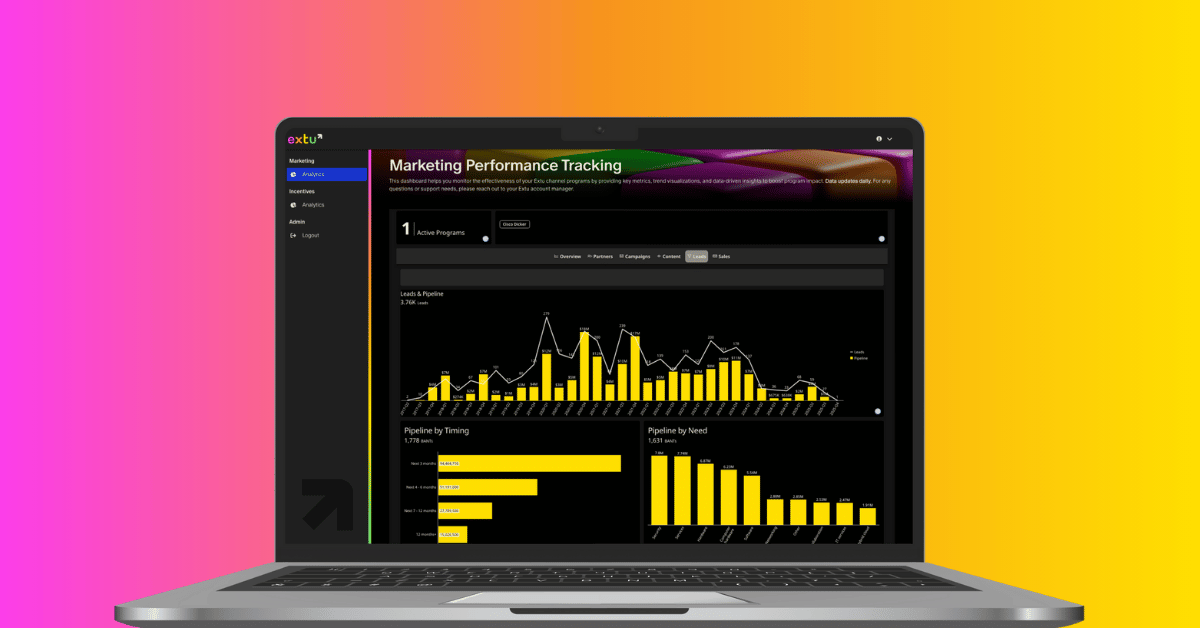
Extu’s Partner Experience Platform was built to meet these requirements. By connecting partner campaign execution, incentive program activity, and partner-submitted sales data in a single operating environment, it captures attribution data as a byproduct of the program itself — rather than trying to reconstruct it from disconnected systems after the fact. Partner activity isn’t a blind spot in the reporting. It’s the primary data source.
The outcomes reflect the architecture. Extu programs produce 80% average partner engagement, a 30% average sales lift, and a 20:1 program ROI. When every partner action — every campaign send, every incentive claim, every sales submission — generates a connected data point, the program becomes visible and optimizable in a way that bolted-together attribution tools simply can’t replicate.
The Bottom Line
B2B marketing attribution is about accountability. It’s the process of measuring what your B2B marketing efforts are worth. Models and software developed around that goal can be very valuable. Organizations using them strategically are investing in a solid competitive advantage.
The challenge of B2B marketing attribution is the nature of B2B itself complex: the buying journey moves through partners and intermediaries, the vendor has limited ability to influence buying decisions, and the winding path from brand awareness to revenue generated is mostly invisible. The attribution tools at B2B marketers’ disposal were mostly designed with B2C in mind. Applied to B2B, they measure what they can see and the rest is unseen.
The organizations revealing that unseen data aren’t necessarily using more sophisticated models. They’re using programs and processes that generate the right data in the first place, connecting signals that link every marketing and incentive dollar to the revenue it produced. That’s the infrastructure that makes real B2B attribution possible.