
When B2B marketing growth stagnates, it’s rarely due to lack of effort. It fails because campaigns are built on chaos. Too many teams still rely on gut feelings, buzzwords, and best guesses to choose themes, build assets, and launch campaigns. Then they scramble to stitch together channel data from Google Analytics, the CRM, their marketing platform, and scattered sales reports… all while racing toward another high-pressure ROI review.
The results are half-baked concepts, inconsistent messaging, frantic production cycles, siloed teams, unclear data, and the constant pressure to produce something “viral” while leaders demand to know why new AI tools haven’t magically solved everything.
It’s exhausting and unsustainable.
But not unsolvable.
When you step back, the real issue isn’t creativity, effort, or tools, but a lack of a connected, repeatable system that gives marketers clarity, consistency, and proof.
In this guide, we’ll show how the right structure, data, and tools can turn scattered efforts into repeatable, scalable B2B marketing growth.
Standing Out to Your Audience
The first hurdle in B2B marketing is simple: if partners don’t notice you, nothing else matters. And it’s an uphill battle. Only 29% of B2B customers are engaged, while 60% are indifferent and 11% are actively disengaged. In other words, most of your audience is tuned out.
There are plenty of reasons your channel partners may have gone numb to your messages. Some of the biggest:
They feel like just a number.
If your outreach is all quota and no connection, partners won’t lean in.
71% of B2B buyers say most sales interactions feel transactional.
You’re inconsistent.
If partners see different messages, offers, or expectations from marketing, sales, incentives, and/or your partners, they’re left guessing what you really stand for.
83% of customers say they’re more loyal to companies that provide consistency across departments.
The experience isn’t great.
If working with you feels like extra work, they won’t give you more data, mindshare, or wallet share.
63% of customers say they’d share more information with a company that offers a great experience.
(PWC)
You don’t have (or use) the right data.
When your data lives in silos, every campaign feels like a guess instead of a tailored conversation.
Only 31% of marketers are fully satisfied with their ability to unify customer data sources.
So what does it take to cut through all of that?
You need a system that helps you do these things reliably:
Consistent, Valuable Campaigns
Get a system that guarantees you can send partners a full campaign every month. For example, with Extu’s Partner Experience Platform, your partners receive a complete campaign—emails, landing pages, and social posts—every single month, created by B2B marketing experts. These campaigns go beyond just product promos; they offer industry insights and thought leadership that partners’ audiences actually want to read. Partners don’t have to do anything extra or pay more for campaigns to reach their audiences’ inboxes automatically.
A More Personalized Partner Experience
Partners shouldn’t feel like just another number. The right rewards program does more than dangle basic incentives. It builds positive, memorable experiences partners connect directly to your brand.
To make this happen, your rewards program needs to deliver:
- Exciting rewards: Offer things that create real excitement and drive behavior change: a family beach vacation, home upgrades, the latest 4K TV, or a gaming console. Those are the kinds of rewards that are personal, emotional, and memorable.
- Tiered options: If you only reward your top partners, you motivate the same few every time. Instead, include meaningful rewards that mid-tier performers can earn too—movie tickets, a night out, new golf balls, or even a good cup of coffee. Small rewards can be personal too, especially if the recipient has their choice among millions of options.
- Flexibility and freshness: No one gets excited about a program that never changes. Reward points that can be spent on millions of items keep things flexible. Take it further with:
- Boosted earning periods like double points for a limited-time product push
- Rotating sales in your rewards catalog with new deals and featured items each month
- Fresh ways to earn that go beyond sales: reward warranty registrations, completed trainings, install certifications, product quizzes, or anything else that helps your partners grow.
The result: a partner experience that feels personal, memorable, and genuinely rewarding, inspiring partners to stay engaged and go the extra mile for your brand.
Better Sales and Customer Data
It’s hard to achieve B2B marketing growth if your data is a mess. Investing in better, cleaner data pays off, giving you the confidence to plan and pivot your channel marketing and sales with accuracy. Here’s how to level up your data game:
- Data Normalization
Whether you call them “leads” or “conversions,” “clients” or “accounts,” pick a single standard and stick to it. Use templates, rules, and mapping tools that force consistency across your CRM, marketing automation, and incentive platforms. If everyone uses their own language, you’ll never get a clear picture.
- Automate Data Hygiene
Manual cleanup isn’t enough. Use automated validation tools that check for missing or incorrect information and fix errors in real time. Real-time analytics and data sync keep your channel running on the same, up-to-date information.
- Deduplication
Duplicate data wastes time and can make your performance metrics meaningless. Take advantage of the deduplication tools in major sales and marketing platforms like Salesforce, HubSpot, and Microsoft. Prevent duplicates at the source whenever possible. You likely already have this ability, so make sure you’re using it.
- Progressive Profiling
Don’t rely on one static form or intake call to tell you everything about a partner or customer. Instead, capture new details over time as people interact with your campaigns, participate in promotions, or make sales. Tools like Extu’s partner engagement platform track every touch, building richer profiles with every action so your data gets better, not just bigger.
- Role-Based Access
Not everyone needs to see everything. Give different departments and partners the right visibility for their roles. The best platforms let you control permissions and access, so each team member or partner sees only the data that’s relevant to them. This keeps your information secure, accurate, and actually useful, instead of cluttered and overwhelming.
Want to dig deeper into B2B marketing data? Check out our blog: B2B Marketing Data: Common Data Gaps and How to Fix Them
Visible ROI and Performance Data
If you want repeatable B2B marketing growth, you need your teams, tools, and data pulling in the same direction. Here’s how to make that happen.
Find a system that centralizes marketing, incentives, and analytics.
Siloed tools = scattered (or no) results data. If your marketing, incentive, and reporting systems don’t talk to each other, you don’t know which activities drive revenue. Look for a platform that unifies these functions so you can create campaigns, manage rewards, and track ROI all in one place. Centralization means less time spent chasing data and more time focused on growth.
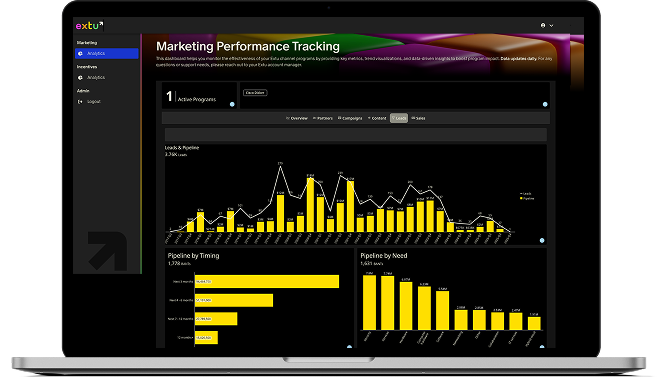
Extu’s Partner Experience Platform gives you a single login and dashboard for everything: campaigns, incentives, sales, and analytics.
Don’t expect less from the software that’s supposed to help you do your job better. AI, automation, and modern platforms can absolutely make you smarter and more productive if you insist on the right capabilities in your CRM, incentive platform, and channel marketing system.
Look for technology that can do the following:
Closed-Loop Reporting
Your platform should connect marketing, incentives, and sales into one loop. Partners should be able to upload invoices, warranty registrations, or receipts directly into the system to claim incentive rewards, for example, and those submissions should tie back to specific campaigns and promotions so you can see verified ROI—not just clicks and opens, but documented proof of revenue sources.
Real-Time Performance Analytics
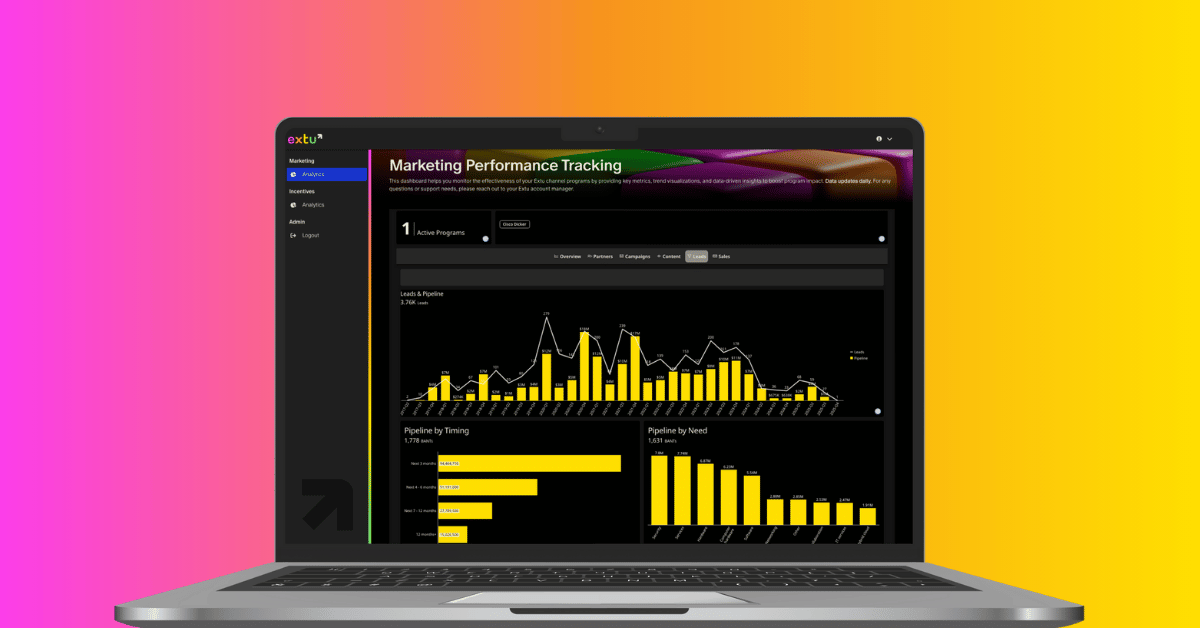
Don’t wait for end-of-quarter reporting or manual spreadsheet merges to understand how your programs are performing. Look for real-time or near-real-time dashboards where ROI, program spend, sales, pipeline, invoice counts, and top drivers refresh automatically.
Segmentation and Personalization
Your tech should help you segment partners and personalize their experience with your brand. You should be able to filter campaigns, promotions, and platform experiences by partner type, campaign, content type, audience role, sector, or company size. Role-based access should make it easy to show each user what matters to them without creating separate systems for everyone.
Campaign Influence Tracking
If your platform can’t show which emails, content pieces, or social posts turned into revenue, it’s not doing enough. You should be able to see exactly which marketing touches influenced pipeline so you can stop funding what doesn’t work and double down on what does.
Performance Dashboards
You shouldn’t have to hunt for performance signals. Dashboards should show top-selling partners, products, and categories, backed by invoices and verified sales data. That way, when you say “these are our top performers” or “these SKUs are driving growth,” you’re speaking from evidence, not perception.
Pipeline Forecasting
A good platform shows not just what happened, but what’s coming. When leads’ timing and need (BANT-style: Budget, Authority, Need, Timeline) are tracked, you can anticipate when revenue is likely to hit and plan your programs, incentives, and campaigns around that reality.
Automated Calculation
Reward points should accrue automatically based on the rules of your program and be awarded on a set cadence (for example, at month-end) without manual reconciliation. This reduces errors, speeds up payouts, and builds trust with partners.
Claims History and Transparency
Every transaction—whether reward claim, approval, or payout—should be logged and easily reviewable by both partners and program managers. A clear claims history builds trust, reduces disputes, and gives you an auditable trail for finance and compliance.
Email Authentication and Domain Checks
Partners should have step-by-step tools to set up proper email authentication (SPF, DKIM, DMARC) without needing to be technical experts. Your platform should verify in real time that a partner’s email domain is configured correctly, so campaigns are delivered instead of bouncing or going to spam.
For more information on these features and others, check out What Does Extu’s Partner Experience Platform Do?
Conclusion
Repeatable B2B marketing growth doesn’t come from one brilliant campaign, but from a system that does the right things again and again. When you show up consistently with valuable content, design rewards that actually motivate partners, and insist on clean, connected data, you stop guessing and start steering.
The tech you choose either supports growth or gets in the way, so don’t settle for platforms that can’t give you clear visibility into what’s working and why. The good news is you don’t have to fix everything at once. Just tightening the pieces that connect marketing, incentives, and analytics can make a big impact on visibility and performance. Do that, and you’ll spend less time scrambling for proof and more time scaling the programs you know are driving real, defensible B2B marketing growth.